

By Hans Scheil, CFP®, CLU®, ChFC®, CASL®, CLTC® — Founder, Cardinal Advisors
Filing for Social Security is one of the only truly irreversible decisions in retirement planning — get it right, or at least get it thoughtful.
Every week someone sits across from me and says some version of the same thing: “My brother told me to file at 62.” Or, “My neighbor said wait until 70, it’s always better.” They’ve all heard something, from someone, somewhere on the internet, and they’re ready to make a decision worth hundreds of thousands of dollars over their lifetime based on it.
Social Security is the base of almost every retirement income plan we build. It’s the one paycheck you can’t outlive, it’s inflation-adjusted, and for a lot of retirees, it’s the largest component of guaranteed income. That’s exactly why the filing decision deserves more than a rule of thumb passed along at Thanksgiving dinner.
Over the years, my team and I have narrowed the decision down to seven areas that matter most. None of them should be evaluated in a vacuum — they only make sense in the context of your full financial picture, your spouse’s numbers, and your health. But if you understand these seven things, you’ll walk into the decision a lot smarter than most people do.
1. Your filing age is a range, not a date — and the range is wide
You can file for Social Security any time between age 62 and age 70, and the difference in your monthly check is enormous. Take someone who worked 35 years and consistently earned at or above the maximum taxable wage base (that cap is $184,500 in 2026). If that person files at 62, they’d collect close to $3,000 a month. Wait until 67 — full retirement age for most people filing this year — and the check jumps to roughly $4,200. Wait all the way to 70, and the largest check being paid out this year is about $5,181 a month.
That’s not a small spread. Every year you delay, your check grows by a meaningful percentage. The people telling you the “right” age to file — on YouTube, in a Facebook group, at your barbershop — are almost always applying a single rule or theory to everyone. We don’t work that way. The right age depends on your spouse’s benefit, your health, your other income sources, and how Social Security fits into your broader retirement income plan. Get to know your own numbers before you accept anyone else’s rule.
2. There’s a cap on how much of your income gets taxed for Social Security
Social Security tax isn’t collected on every dollar you earn — only up to a cap, called the maximum taxable wage base, which is $184,500 in 2026. Earn more than that in a year, and the extra income isn’t subject to Social Security withholding (though Medicare withholding, which has no cap, keeps going). That cap also rises with inflation every year — it was just $53,400 back in 1991 — and your eventual benefit is calculated using your 35 highest-earning years relative to what the cap was in each of those years.
This number matters for another reason: it’s one of the levers policymakers talk about pulling to help shore up Social Security’s long-term finances. Raising or eliminating the cap would bring in more revenue for the system. Nothing has changed under current law, but it’s worth knowing this is part of the ongoing conversation.
3. If you filed too early, you may be able to undo it
Here’s a scenario we see often: someone retires, files for Social Security right away, and then comes to us a year later to build a full retirement plan. Once we look at their whole picture — a spouse who’s younger, a healthy IRA or 401(k) balance — we often realize they’d have been better off delaying and living off retirement account withdrawals in the meantime.
If you’re within 12 months of filing, you have an option: a formal withdrawal of application, sometimes called a Social Security “do-over.” You repay every dollar you’ve received (no interest), and Social Security treats it as if you never filed. Your benefit is suspended and starts growing again from there. We’ve had clients repay a few thousand dollars in benefits and unlock hundreds of extra dollars a month for life as a result — it can be a very small price for a much better long-term outcome.
One related trap to watch for: if you file before your full retirement age and continue working, there’s an earnings limit — $24,480 in 2026. Earn more than that from a job, and Social Security will withhold part of your benefit. This isn’t a cliff (a dollar over the limit won’t wipe out your check), but earning well above it while collecting reduced early benefits is a common and costly mistake.
4. Don’t just look at your own benefit — look at your spouse’s
This is the piece I see overlooked more than any other. People run the math on their own filing age, weigh how many years of checks they’d give up by waiting, and decide based on that alone. What they miss is the spousal benefit.
While both spouses are alive, a lower-earning (or non-working) spouse may be eligible for up to 50% of the higher earner’s full retirement age benefit — even if their own work record would pay less than that. Using the numbers from above, if the higher earner’s full retirement age benefit is $4,200, the spouse could be eligible for up to $2,100.
More important than that, though, is what happens when the first spouse passes away. Regardless of who dies first, the smaller of the two checks stops, and the survivor keeps the larger one — for the rest of their life. That means delaying the higher earner’s filing age doesn’t just produce a bigger check while both spouses are alive; it sets the income floor the surviving spouse will live on, potentially for decades. This should never be a one-person decision.
5. The cost-of-living adjustment compounds — and you don’t have to file to get it
Social Security’s annual cost-of-living adjustment (COLA) is meant to keep your check’s buying power roughly level with inflation. It’s also politically charged, since a higher COLA raises everyone’s benefit and adds pressure to the system’s long-term financing. Here’s how it’s run over the last eight years:
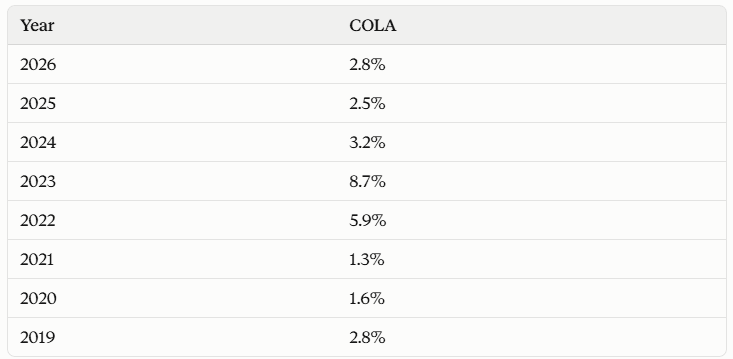
Most years land in a fairly modest range. The two outliers — 8.7% in 2023 and 5.9% in 2022 — reflect the high-inflation stretch coming out of COVID and pulled the eight-year average up to roughly 3.6% annually. Averaged over time, that’s enough that a benefit roughly doubles in about 20 years.
That matters enormously for the delay-versus-file-now math. Someone who waits until 70 to file $5,181 a month isn’t just protecting themselves — if they have a surviving spouse who lives another 20 years, that check (with COLA applied) could grow to over $10,000 a month by the time it’s needed most. Waiting to file the higher earner’s benefit functions a lot like a life insurance policy for the survivor. And a detail that trips people up: you don’t have to be receiving benefits to get the COLA. Your benefit continues to grow with both the delayed retirement credit and the annual COLA whether you’ve filed or not.
6. Your filing age has estate planning implications for your spouse
This connects directly to points four and five. In a marriage, the smaller Social Security check disappears when the first spouse dies, and the larger one continues for the survivor. Maximizing that larger check — by delaying the higher earner’s filing age when it makes sense — is one of the most effective things you can do to protect a surviving spouse’s income.
This isn’t only relevant to couples with one high earner and one low earner. Even when both spouses have substantial benefits of their own, losing the smaller check at the first death is still a real reduction in household income, and it often means the survivor needs to draw more from an IRA or other retirement account to make up the difference. That has its own tax consequences worth planning around in advance, not after the fact.
7. Yes, you can owe federal tax on Social Security — and no, that recent law didn’t eliminate it
Up to 85% of your Social Security benefit can be counted as taxable income, depending on your total income in retirement. The formula boils down to: modified adjusted gross income + half your Social Security benefit = combined income. Once your combined income crosses a threshold, a portion of your benefit becomes taxable. Those thresholds — $25,000 for a single filer, $34,000 for a married couple — haven’t been adjusted for inflation since 1990. That means more retirees get pulled into paying some tax on their benefits every year, simply because the thresholds never move while incomes do.
In broad terms: if Social Security is your only income, you likely won’t owe any tax on it. Add a modest amount of other income, and you’re probably still fine. Add a few thousand dollars a month in other income, and some of your benefit becomes taxable. Get into higher income territory, and up to 85% of your benefit is taxable — though that figure describes how much of your check is counted as income, not a tax rate on it.
Eight states also tax Social Security benefits at the state level: Colorado, Connecticut, Minnesota, Montana, New Mexico, Rhode Island, Utah, and Vermont. Each has its own rules and exemptions, so the impact varies. The other 42 states and Washington, D.C. don’t tax Social Security at all.
One common misconception: recent tax legislation did not eliminate taxes on Social Security. What it did add is an extra $6,000 deduction per person for taxpayers over 65 (on top of the standard deduction), which phases out above certain income levels. That can meaningfully reduce your tax bill, but it doesn’t change the underlying calculation of how much of your Social Security is taxable in the first place.
One footnote worth knowing: the formula technically uses your modified adjusted gross income, which for most people is identical to their regular adjusted gross income — with one common exception. If you hold tax-free municipal bonds, that interest gets added back in for purposes of this calculation, even though it’s federally tax-exempt otherwise.
It all comes back to the plan
None of these seven items should be decided in isolation. Your filing age affects your spouse’s income now and in survivorship, your tax bill, and how much you’ll need to draw from your IRA or 401(k) to fill the gap while you wait. When we build a retirement income plan, Social Security is where we start, because it’s the foundation everything else gets stacked on top of.
If you take one thing away from this, let it be this: don’t let a rule of thumb — or your brother-in-law — make this decision for you. Pull your Social Security statement, look at your spouse’s numbers alongside your own, and have this conversation as part of a real plan, before you file. Once you do, there’s very little room to change your mind.
Have questions about your own Social Security filing strategy? Reach out to our team at Cardinal Advisors — this is what we do every day.


