

Oct 26, 2026 · @Hans Scheil
Turned down for long-term care insurance because of cancer, a stroke, heart disease or diabetes? A long-term care annuity may still get you covered, and here is how six of my clients did it.
By Hans Scheil, CFP®, CLU®, ChFC®, CASL®, CLTC®
In my experience, the hardest conversation about long-term care isn’t with someone who refuses to plan. It’s with someone who wants to plan and was told no.
They filled out the application. They did the doctor’s records and the phone interview. Then the letter came back: declined. Maybe it was the cancer they’re being treated for. Maybe the stroke three years ago, the heart surgery or the diabetes. Either way, they walked away believing the door was closed for good.
For a lot of those people, that’s no longer true. Over the last four or five years, long-term care built on an annuity has become far more widely available. It now covers many people that traditional long-term care insurance and life insurance with long-term care benefits simply won’t touch.
Why an annuity instead of life insurance?
If you’ve followed my work, you’ve heard me talk a lot about life insurance with long-term care benefits. It’s still a good tool. But for a growing number of retirees, the annuity version is the better fit, for a few reasons.
The underwriting is easier. People actively being treated for cancer can qualify for some of these annuities. So can many people who had a stroke a year or more ago and are doing well, people with heart disease or atrial fibrillation, and most people with diabetes who haven’t had complications like vision loss. Approval often takes a simple health questionnaire and a short video interview, sometimes within a day.
If you don’t use it, you don’t lose it. Your money sits in the annuity and keeps earning interest. Part of that interest pays for the long-term care rider. If you never need care, the full annuity value goes to your beneficiaries.
The benefits are tax-free. Long-term care benefits paid from the policy come to you free of income tax. Compare that with paying for care by pulling money out of an IRA, where every dollar is taxed.
They’re indemnity benefits. Once you qualify for care under the policy terms, you receive a monthly check. You don’t have to send in receipts or prove what you spent.
There’s built-in inflation protection. As the annuity grows, the long-term care benefit grows too, usually by more than the annuity itself.
The cost is fixed. The charge for the long-term care rider is set in the contract for every year. The insurance company can’t raise it later.
An old annuity or policy can fund it, tax-free. A 1035 exchange lets you move an existing annuity or the cash value of a life insurance policy into one of these contracts without paying tax on the gains. Say you put $100,000 into an annuity years ago and it’s worth $160,000 today. You could move the full $160,000 over, owe no tax on the $60,000 of growth, and turn it into roughly three times that amount in long-term care benefits.
One limit: no IRA money. These policies can’t be bought with IRA or 401(k) dollars. Taking the money out of an IRA first usually creates too large a tax bill, so they work best with savings, CDs, or an existing annuity or life policy.
Six real clients, six different reasons
Every one of these clients could have paid for care out of their own pocket. T
hey chose not to, because insurance turns each dollar of premium into several dollars of care. Here’s what they put in and what their policy illustrations show.
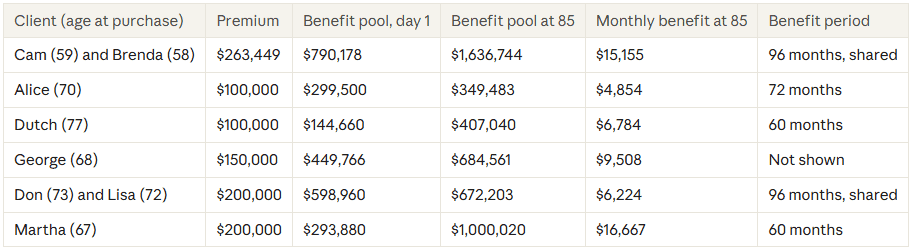
Cam and Brenda watched Cam’s parents go through long-term care. They no longer needed as much life insurance, and one of Cam’s old policies had built up $263,449 of cash value. Through a 1035 exchange, we moved it into an annuity that covers both of them, even though the original policy was in Cam’s name alone.
Dutch was a tough customer who wanted plenty of assurances before handing anyone $100,000. At 77, life insurance would have meant full medical underwriting, and a few health issues would have come up. With the annuity, he answered a questionnaire, did a video interview and was approved in about a day. The money came out of a CD.
Alice, Dutch’s sister, sat in on his meeting and decided to put in the same $100,000. She chose a different insurer with a stronger financial rating. Her monthly benefit is smaller, but it pays for 72 months instead of 60.
George was turned down for long-term care and life insurance in 2023, while his wife was approved. Until then, he was self-funding his own care risk, which would have meant drawing down his IRA and paying tax on every dollar. When a new annuity product came out, we went back to him, and this time he qualified.
Don and Lisa first looked at life insurance with long-term care benefits. They didn’t like that its death benefit would be less than what they put in. With the annuity, the amount going to their family never drops below their $200,000 and grows modestly over time.
Martha, at 67, has a serious health condition and was caring for her own mother at the time. She knew her odds of needing care were high. She started at $100,000, then chose $200,000 after seeing the numbers. By 72, her policy would pay $11,519 a month for 60 months.
These figures come from each client’s actual policy illustration. Future benefits depend on how the annuity grows, and your own numbers will depend on your age, health and state.
One tool, not the whole toolbox
Long-term care is the single risk most likely to upend a retirement plan. I sit across from families living through it every week, and it’s hard on everyone.
The annuity is one of several ways to plan for it. Traditional long-term care insurance is still the lowest-cost option, paid monthly or yearly for life. Life insurance with long-term care benefits works well for many people, especially younger and healthier ones. Short-term or convalescent care, about a year of coverage, is worth a look too. Which one fits depends on your health, your age, where your money is and the rest of your plan.
3 steps to take this week
- Find money without a job. Look for an old annuity, a CD or a life insurance policy with cash value that no longer has a clear purpose in your plan.
- Don’t assume the answer is still no. If you were declined before, write down your health conditions and when they were diagnosed. Underwriting on these products has changed.
- Check where your savings sit. List what’s in IRAs and 401(k)s versus regular savings, since these policies need non-IRA money.
See the numbers walked through. In this video, Tom Griffith, Drew Sumallo and I go through all six of these clients in detail. The full policy illustrations are in the show notes at CardinalGuide.com.
Plan before you need it
You can’t buy this coverage once you need care. The time to look is while you still qualify, and for many people who were turned down before, that time may be now.
If you’d like to see what a long-term care annuity could look like at your age and in your state, call us at 919-535-8261. We’ll run the numbers for your situation, not someone else’s.


