

By Hans Scheil · Nov 9, 2026
Most couples plan around a nest egg. What they really need in retirement is a paycheck that can’t run out. Here’s how a lifetime income annuity can fill that role, and when it shouldn’t.
On the first of every month, $1,850 lands in my checking account. My wife and I have received that deposit for five years now, and it’s tax-free.
It comes from three lifetime income annuities I turned on at 63. They were IRA money I converted to a Roth about 10 years earlier. As long as either of us is alive, that money keeps coming, whether we live to 85 or 105.
When couples sit down with me to plan retirement income, they usually focus on one number: the size of their portfolio. Very few have asked the more important question. How much guaranteed monthly income will we have, and will it last as long as the longer-lived spouse?
Insurance, not an investment
A lifetime income annuity is insurance. It protects against the one risk none of us can predict: how long we’ll live. As a couple, you don’t know how long the longer-lived spouse will need income.
Because of that, I never compare these annuities to stocks. If I compare them to anything, it’s bonds. In the plans we build, the annuity replaces part of the fixed-income side of a client’s portfolio, not the growth side.
The insurance company guarantees two things: your principal and your income for life. You trade some flexibility on that slice of money for an income stream you can’t outlive.
Four plans, four different reasons
The annuity looks different in every plan we build. Here are four recent examples from our office, each bought for its own reason.
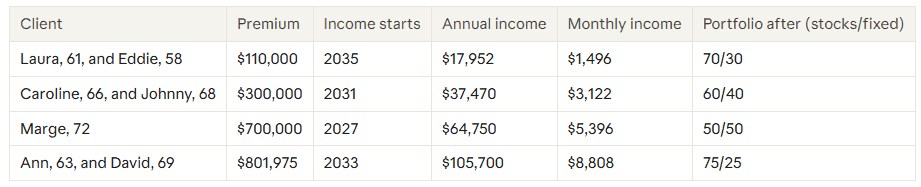
Laura and Eddie are still working and plan to retire around 2035. Even after delaying Social Security, their checks won’t cover their spending. They moved $110,000 of IRA money into an annuity that will add about $1,500 a month once they retire.
Caroline and Johnny are building their guaranteed income slowly. Johnny still works and earns a good salary, so they used Roth and non-qualified money. That keeps the income from adding much to their tax bill while he works.
Marge is a widow who sold rental properties she and her late husband owned. The buyer paid off the installment sale early, and her monthly income dropped sharply. She’s very risk averse and didn’t want stock market exposure. We placed part of the lump sum in an annuity that starts paying about $5,400 a month after her next birthday.
Ann and David have plenty of money. Ann’s deferred compensation pays like a salary until 2032, and they wanted a paycheck to replace part of it. Ann’s parents are in their 90s, so longevity is a real possibility in their family. The guaranteed income also lets them stay the most aggressively invested of these four couples.
The number that shows whether it’s worth it
Almost none of these clients asked about the internal rate of return. They bought for the security. But as fiduciaries, we run the number on every plan, because it tells us how the annuity stacks up against bonds.
The internal rate of return is the effective interest rate the annuity earns, based on the income it pays and how long you collect it. If we knew the exact date each client would die, we could calculate it precisely. We don’t, so we run it at several ages.
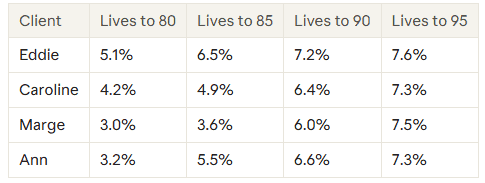
The pattern is the same in every case: the longer you live, the better the annuity does. Marge’s 3% at age 80 is the low end, and that assumes she dies just seven years after the income starts. If she reaches 90 or 95, her return climbs to 6% to 7.5%.
And if someone dies early, the money isn’t simply lost. Any remaining cash value goes to the beneficiaries.
Four features most people don’t know about
You can convert to a Roth before the income starts. Many people fund these annuities with IRA or 401(k) money. A Roth conversion before income begins can make every future payment tax-free, as it did for me.
Income can double for chronic illness. With the annuity we use, if you qualify for the chronic illness benefit, your income doubles for up to five years. My $1,850 a month would become $3,700. It isn’t a replacement for long-term care insurance, but it’s a meaningful backstop.
There’s a cash value and a death benefit. A common fear is that the insurance company keeps everything if you die. With this type of annuity, that isn’t the case. If my wife and I both died tomorrow, about $180,000 to $190,000 would go to our heirs.
The longer you wait, the larger the check. Like Social Security, you can start income earlier for less or wait for more. Each of our four clients picked a start date that fits the rest of their plan.
The trade-offs, and who should skip it
The income amount never changes, so there’s no built-in protection against inflation. That’s the biggest drawback, and it’s why we never put all of a client’s money into one of these. The 50% to 75% we leave in stocks is there to keep pace with rising costs.
An annuity also isn’t right for everyone. It solves one problem: a gap between what you spend and the guaranteed income you have. If Social Security and pensions already cover your needs, you probably don’t need one. Some clients see the numbers and simply don’t like the idea, and we build their plan another way.
3 steps to take this week
You don’t need an adviser to start. You need about 15 minutes and your numbers.
- Add up your monthly spending. Include what you spend now and what you expect to spend in retirement.
- List your guaranteed income. Pull your Social Security statements at SSA.gov and add any pensions. Then look at what the survivor would receive if one of you died.
- Find the gap. If guaranteed income falls short of spending, that gap is what a lifetime income annuity is designed to fill. If there’s no gap, you likely don’t need one.
Build the paycheck before you need it
Your portfolio is one thing. What matters most in retirement is the money that arrives each month, money you can spend without worrying about the market. For me, the most important part is knowing my wife will have that check if she outlives me.
If you’d like to see these four plans in more detail, watch our video walkthrough and the show notes at CardinalGuide.com. Or call us at 919-535-8261, and we’ll run the numbers for your household.
Annuity guarantees are backed by the claims-paying ability of the issuing insurance company. The examples above reflect specific clients’ ages, start dates and product terms; your results will differ.


